March 20 came and went this year, and most folks probably didn't mark the occasion. But for those of us who care about the bones and blood of country music, it's a date that deserves a moment of reflection. That was the day in 2011 when Ralph Mooney, arguably the most influential steel guitar player in the history of the genre, played his final note. He was 82 years old.
If you don't know the name, you're not alone. Mooney spent his entire career in the shadows of the stars, backing them onstage and making them sound better than they had any right to. But if you've ever tapped your foot to Ray Price's "Crazy Arms," felt the heartbreak in Merle Haggard's "Swinging Doors," or reveled in the outlaw swagger of Waylon Jennings, you've heard Ralph Mooney. You've felt his influence, even if you didn't know it.
Here on the Whiskey Wisdom blog, we like to raise a glass to the sidemen, the players who built the foundation while the stars got the spotlight. Ralph Mooney deserves more than a glass. He deserves a whole damn bottle.
From Oklahoma to California: The Making of a Steel Guitar Pioneer
Ralph Mooney was born on September 16, 1928, in Duncan, Oklahoma. Like so many Okies during the Dust Bowl era, his family headed west when he was just a boy. At age 12, Ralph moved to California to live with his sister and her husband. That brother-in-law would become the first of many teachers, showing young Ralph the basics on guitar, fiddle, and mandolin.
But the moment that changed everything came when Ralph heard Leon McAuliffe's "Steel Guitar Rag." That sound, that crying, singing, otherworldly wail of the steel guitar, grabbed hold of him and never let go. Ralph learned to play the song on his flat-top guitar using a knife as a slide, but once he figured out what instrument McAuliffe was actually playing, he had to have one.
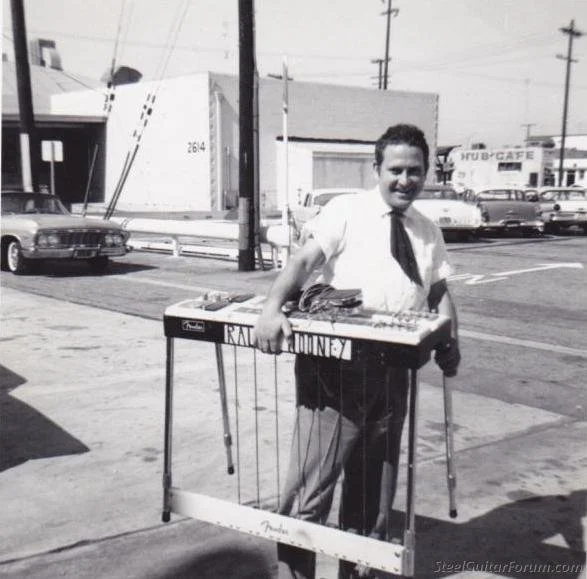
Ralph Mooney with his trusty Fender 1000 pedal steel guitar
Here's where the story gets good. Ralph didn't have money for a proper pedal steel. So he built his own. He started with a Magnatone double eight-string non-pedal steel and modified it with household materials. According to legend, the pedals were held in place with coat hangar wire, and he used chicken wire strung diagonally across the legs, which were pushed up into non-threaded sockets, to stabilize them. It was crude, it was ugly, and it was absolutely brilliant.
That homemade instrument caught the attention of Leo Fender himself, who borrowed it to study the design. Fender gave Ralph a proper Fender model to play in exchange. From those humble, chicken-wire beginnings, a legend was born.
This was the Bakersfield Sound in its earliest days, raw and real and built on steel guitar.
"Crazy Arms": The Song That Changed Everything
Before Ralph Mooney became famous for his steel playing, he made his first mark as a songwriter. And what a mark it was.
In 1949, while playing with Wynn Stewart's band in Las Vegas, Ralph was going through a rough patch. His drinking had gotten out of hand, crawling, falling-down drunk according to his own recollection. His wife had finally had enough and left him. Heartbroken and hungover, Ralph poured that pain into a song. He called up his friend Chuck Seals, and together they wrote "Crazy Arms."
The song sat around for a few years until Ray Price recorded it in 1956. Price reworked some of the lyrics and added a walking bassline in 4/4 time, creating what would become known as the “Ray Price" shuffle”. The single shot to #1 on the Billboard country charts and stayed there for 20 weeks. It established Ray Price as a major star and introduced a rhythmic feel that would become the backbone of honky tonk music.
"Crazy Arms" was also one of the first country songs to feature a full drum kit. That might not sound revolutionary today, but at the time, it was groundbreaking. The Nashville Sound, the Bakersfield Sound, even outlaw country, none of it would have sounded the same without the innovations that started with this one song.
Jerry Lee Lewis recorded it for his Sun Records debut. Willie Nelson had a top 20 hit with it. Marion Worth, Patsy Cline, and countless others cut their own versions. Ralph Mooney earned royalties from that song for over six decades. As he once quipped, "I would starve to death if it wasn't for those royalty checks."
The Bakersfield Sound Era: Wynn Stewart, Buck Owens, and Merle Haggard
Ralph Mooney didn't just write the songs that defined an era. He played on them too. His steel guitar became the signature sound of the Bakersfield Sound, that hard-edged, telecaster-and-steel alternative to the polished Nashville productions of the 1960s.
Wynn Stewart: The Beginning
By 1950, Ralph had become a regular in the house band for the Squeakin' Deacon radio show in Los Angeles. It was there he met a 16-year old singer named Winford Stewart, who shortened his name to "Wynn" after winning so many talent contests. Ralph joined Wynn's band and played on his early sessions for Capitol Records, including Stewart's first major hit "Waltz of the Angels."
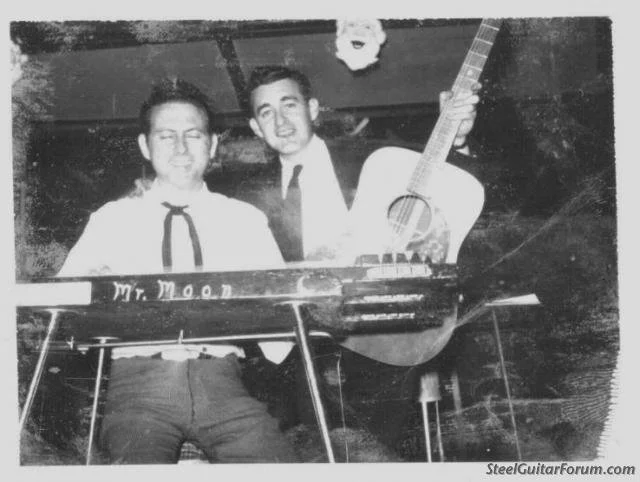
Ralph Mooney and Wynn Stewart in the early days
The two would play together off and on for decades. During the early 1960s, they were the house band at the Nashville Nevada Club in Las Vegas, playing multiple shows nightly for whoever wandered in. It was during one of those late-night sets, while Wynn was off somewhere, that Ralph helped discover the next giant of country music.
Merle Haggard was in the audience that night in 1962. Guitarist Roy Nichols recognized him, called him on stage, handed him a guitar, and told Merle to play while Nichols took a bathroom break. Ralph asked Haggard if he could sing. Merle said he could, and they ran through some Marty Robbins songs. When Wynn Stewart heard them from the crowd, he was impressed enough to offer Haggard a job playing bass and singing backup on the spot.
Haggard's first Capitol single, "Sing a Sad Song," was a Wynn Stewart composition featuring Ralph and the rest of Wynn's band. It reached #19 on the country chart and launched one of the greatest careers in country music history.
Buck Owens: The Hits Keep Coming
By the late 1950s, Wynn Stewart's drinking had made working with him unreliable. Ralph started picking up session work and playing with other bands. In 1958, he began recording with a young Buck Owens.
Ralph's steel guitar kicks off some of Buck's earliest hits and drives them all the way through. "Under Your Spell Again," "Above and Beyond," "Excuse Me (I Think I've Got a Heartache)" - that's all Ralph Mooney. His playing was so integral to Buck's sound that when Owens formed the Buckaroos in 1963, he specifically chose Jay McDonald for pedal steel because, as Buck put it, McDonald "could mimic the way Ralph Mooney played, so he was just the person I needed to help make what we played onstage sound like my records sounded."
That's the kind of influence we're talking about. Ralph Mooney was the standard by which other steel players were measured.
For more on the Bakersfield Sound and the players who built it, check out our post on Don Rich: The Player's Player Who Built the Bakersfield Sound.
Merle Haggard: The Strangers
When Merle Haggard formed his band, the Strangers, in 1965, Ralph Mooney was the obvious choice for steel guitar. He played on Haggard's first four albums, all of them top 10 country hits. "Swinging Doors," "The Bottle Let Me Down," "(All My Friends Are Gonna Be) Strangers" - Ralph's steel is all over those classics.
But Ralph's tenure as a full-time Stranger was short-lived. In 1967, the band got caught in a snowstorm in Minneapolis. Tired of being stuck in a hotel, Ralph decided he'd had enough. He tried to steal the Strangers' tour bus and drive it home himself. He didn't get far before being stopped and sent home. It was the kind of wild, self-destructive behavior that country songs are made of, and it cost him the gig with Haggard.
But Ralph Mooney was too good to stay unemployed for long.
"Pick It, Moon!": Two Decades with Waylon Jennings
In late 1970, Ralph Mooney joined Waylon Jennings' band, the Waylors. He would stay for 22 years, until Waylon retired from touring in 1992. This was the outlaw country era, and Ralph's steel guitar was the perfect fit for Waylon's rough-edged, rock-influenced sound.
Waylon knew what he had in Mooney. On the live album Waylon Live, he introduces Ralph as "the most imitated steel guitar player and the best one by far... the great Ralph Mooney." In his autobiography, Waylon wrote, "The band could do just about anything... Mooney was at the heart of it. He was a cult legend in his own right, a steel-guitar genius, and he was in his heyday."
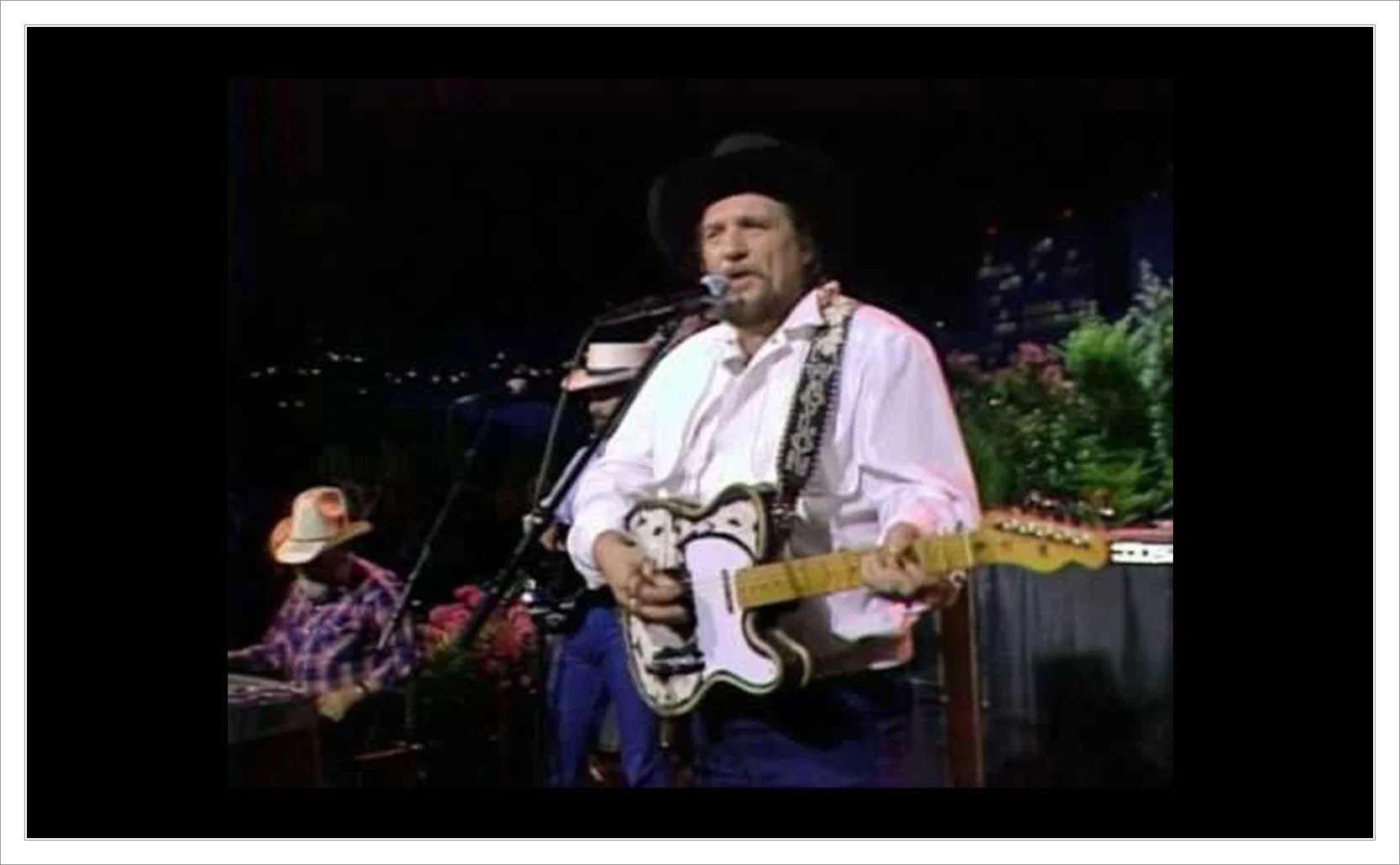
Ralph Mooney with Waylon Jennings and The Waylors
Drummer Richie Albright recalled Waylon saying it simply: "Hell, there's only one steel guitar player, and it's Ralph Mooney."
Waylon made sure the audience knew who was making that sound. He'd call out "Pick it, Moon!" before Ralph's solos, turning the spotlight on the sideman. On Waylon Live, he prompts Mooney to "Show 'em the foot that made Merle Haggard a star." On I've Always Been Crazy, covering Haggard's "Tonight the Bottle Let Me Down," Waylon slyly says, "Eat your heart out, Haggard."
Ralph played on the albums that defined outlaw country: Lonesome, On'ry and Mean, Honky Tonk Heroes, Dreaming My Dreams, Are You Ready for the Country. He wasn't just keeping up with the changing times. He was helping define them.
And Ralph wasn't just a steel player. He played dobro too, sometimes layering both instruments on the same song, like on "You Ask Me To." He played on Jessi Colter's albums too, including her crossover hit "I'm Not Lisa."
The honky tonk sound that Ralph helped create is still the standard we measure country music against today.
The Sound, The Gear, The Legacy
Ralph Mooney's sound was instantly recognizable: clean, precise, with just the right amount of twang and cry. He wasn't a show-off. He played what the song needed, nothing more, nothing less. That restraint, that taste, is what separated him from the pack.
His gear evolved over the years, but he stayed true to his roots. After that homemade chicken-wire creation, he moved to a Fender 1000, then a Sho-Bud gifted by Waylon and the band. He primarily used the E9 neck, with a dobro-style open G tuning on the second neck instead of the more common C6. Later in life, he played instruments made by GFI.
For those of us who geek out on guitars, Ralph's homemade steel and his evolution through Fender, Sho-Bud, and GFI is the stuff of legend.
In 1968, Ralph recorded an instrumental album with guitarist James Burton called Corn Pickin' and Slick Slidin'. It's a masterclass in country guitar playing, two legends trading licks and showing the rest of us how it's done.
The industry finally gave Ralph his due in 1983, inducting him into the Steel Guitar Hall of Fame. But the real recognition came from his peers. Marty Stuart, who grew up listening to Ralph's playing, called him "the most influential country musician he’s ever known." In 2010, Marty brought Ralph to Nashville to play on Ghost Train: The Studio B Sessions. Ralph played steel on the album, co-wrote a song with Marty, and delivered an instrumental version of "Crazy Arms." It would be his final recording.
Why Ralph Mooney Matters
Ralph Mooney died on March 20, 2011, at his home in Kennedale, Texas. He left behind a legacy that most musicians can only dream of. From the Bakersfield Sound to outlaw country, Ralph Mooney played the soundtrack to an era. He wrote one of the most important songs in country music history. He influenced generations of steel players who are still trying to capture that Mooney sound.
Shooter Jennings, Waylon's son, put it best when Ralph passed: "He was a pioneer and a visionary . . . he coveted his instrument and ultimately improved it. I feel he was one of the last keys to the old outlaw sound, and now it's gone forever. Thank God for those albums."
The folks at Saving Country Music were even more direct: "Ralph Mooney was the best steel guitar player ever. Period. End of story."
But here's the thing about Ralph Mooney. He wasn't just a great player. He was a reminder of what country music used to be, and what it still should be. No smoke machines, no backing tracks, no AutoTune. Just a man and his steel guitar, playing from the heart, making music that mattered.
That's the kind of authenticity we celebrate here at I Drank with Hank. That's what real country music is all about.
So the next time you're listening to Waylon, or Merle, or Buck Owens, or Ray Price, listen for that steel guitar. That's Ralph Mooney. That's the sound of country music, pure and true.
Raise a glass, friends. Pick it, Moon.